Puran
TIL Photos Reading Weekly Current Shelf Search Stats
  • TIL: AI Weekly Newsletter of Week 17

    TIL: AI Weekly Newsletter of Week 17

    đŸ’»

    AI-Assisted Programming

    Go Read Peter Naur’s “Programming as Theory Building” and Then Tell Me That LLMs Can Replace Human Programmers

    Dave Gauer invokes Peter Naur’s seminal essay “Programming as Theory Building” to argue that LLMs lack the essential “theory” human programmers develop through active engagement with a codebase, and thus cannot truly replace human developers.

    To replace human programmers, LLMs would need to be able to build theories by Ryle’s definition or Naur must be wrong about the nature of programming.

    I’m betting neither is true.

    Andrej Karpathy on AI-Assisted Coding

    Andrej Karpathy’s tweet outlines a deliberate, step-by-step “inner loop” for AI-assisted coding—distinguishing serious, production-grade work from casual “vibe coding.” He emphasizes a controlled, incremental, and learning-focused workflow that:

    1. Feeds the model just enough context.
    2. Requests high-level approaches before code.
    3. Manually reviews unfamiliar APIs.
    4. Tests and commits changes.

    Vibe Coding Is Not an Excuse for Low-Quality Work

    Vibe coding—rapid, AI-driven code generation based on conversational prompts—can supercharge productivity, but Addy Osmani warns it must never be an excuse for substandard engineering. He frames AI as “your intern, not your replacement,” and provides a concise field guide for responsible AI-assisted development.

    Let’s acknowledge the good: AI-assisted coding can be a game-changer.
    

    However, as any seasoned engineer will tell you, speed means nothing if the wheels fall off down the road.
    

    Think of these as the new “move fast, but don’t break everything” handbook—a set of guardrails to keep quality high when you’re vibing with the code.

    Rules:

    1. Always review AI-generated code.
    2. Establish coding standards and follow them.
    3. Use AI for acceleration, not autopilot.
    4. Test, test, test.
    5. Iterate and refine.
    6. Know when to say no.
    7. Document and share knowledge.

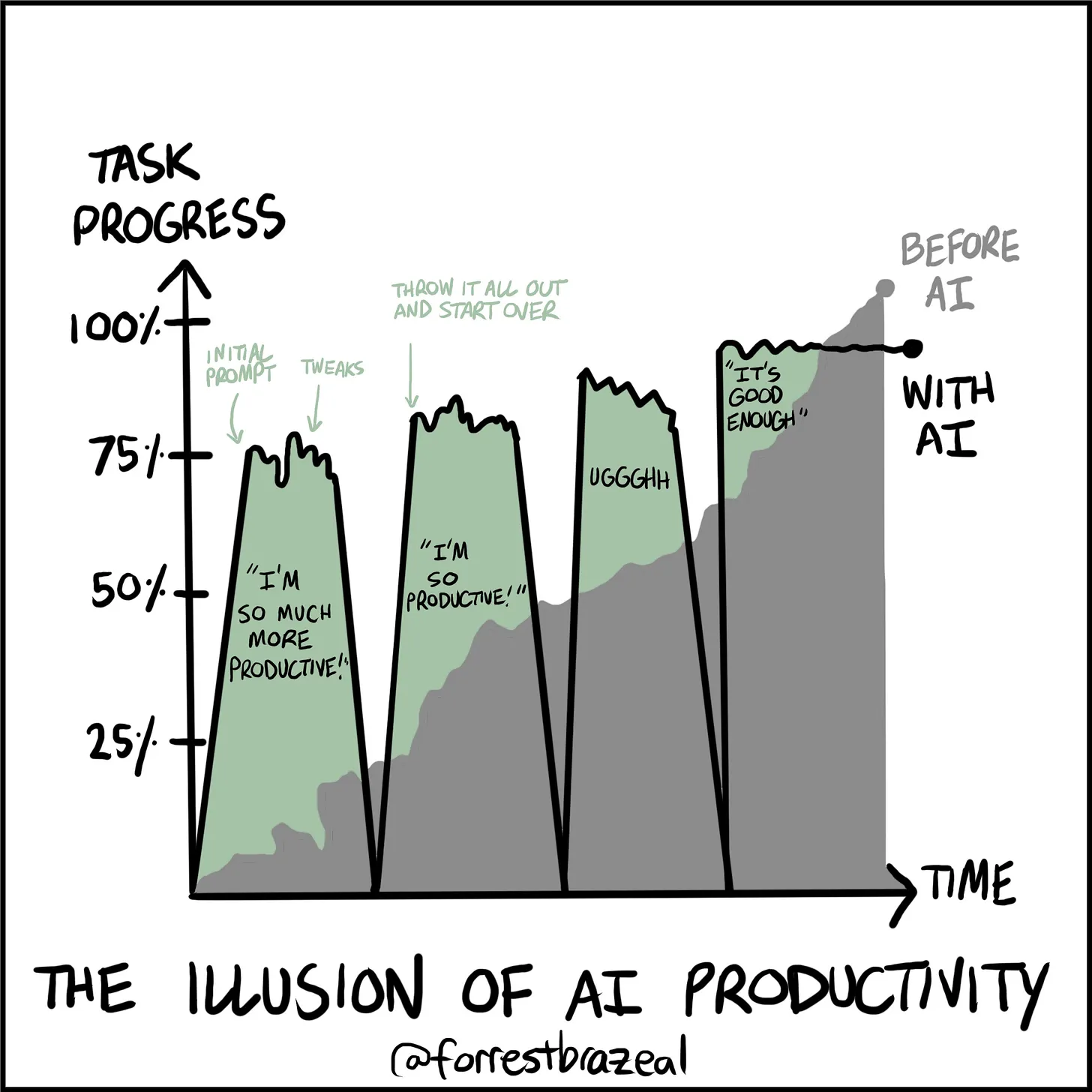
    the illusion of ai productivity

    New Model Releases

    OpenAI: Introducing Our Latest Image Generation Model in the API

    OpenAI is bringing the natively multimodal model that powers ChatGPT to the API via gpt-image-1, enabling developers and businesses to integrate professional-grade image generation directly into their own tools and platforms.

    gpt image api

    Dia – Ultra-Realistic One-Pass TTS

    Dia is a 1.6 B-parameter text-to-speech model from Nari Labs, capable of generating ultra-realistic dialogue in a single pass.

    dia

    Cutting-Edge Vision & Captioning

    Describe Anything: Detailed Localized Image and Video Captioning

    Describe Anything is a state-of-the-art framework for detailed localized captioning (DLC) that empowers users to obtain rich, context-aware descriptions of specific regions within images or videos—specified via points, boxes, scribbles, or masks. It sets a new standard by combining innovative architecture, scalable data strategies, and robust evaluation.

    dam

    Developer Productivity Tools

    DeepWiki – Automatic Wiki Docs for GitHub Repos

    Devin AI has launched DeepWiki, a free tool that generates structured, wiki-style documentation for any GitHub repository. It simplifies understanding unfamiliar codebases by providing a comprehensive overview directly from the repo URL.

    → 11:20 PM, Apr 28
    Also on Bluesky
  • TIL: Top AI News of Week 16

    TIL: Top AI News of Week 16

    đŸ’»

    AI as Normal Technology

    The essay “AI as Normal Technology” by Arvind Narayanan and Sayash Kapoor, presents a perspective that contrasts with both utopian and dystopian narratives surrounding artificial intelligence (AI). Instead of viewing AI as an autonomous, potentially superintelligent entity, the authors argue that AI should be considered a “normal technology”—a tool that, while transformative, remains under human control and integrates gradually into society.

    To view AI as normal is not to understate its impact—even transformative, general-purpose technologies such as electricity and the internet are “normal” in our conception. But it is in contrast to both utopian and dystopian visions of the future of AI which have a common tendency to treat it akin to a separate species, a highly autonomous, potentially superintelligent entity.
    The statement “AI is normal technology” is three things: a description of current AI, a prediction about the foreseeable future of AI, and a prescription about how we should treat it.
    …
    A note to readers. This essay has the unusual goal of stating a worldview rather than defending a proposition. The literature on AI superintelligence is copious. We have not tried to give a point-by-point response to potential counter arguments, as that would make the paper several times longer. This paper is merely the initial articulation of our views; we plan to elaborate on them in various follow ups.

    ai-as-normal-technology

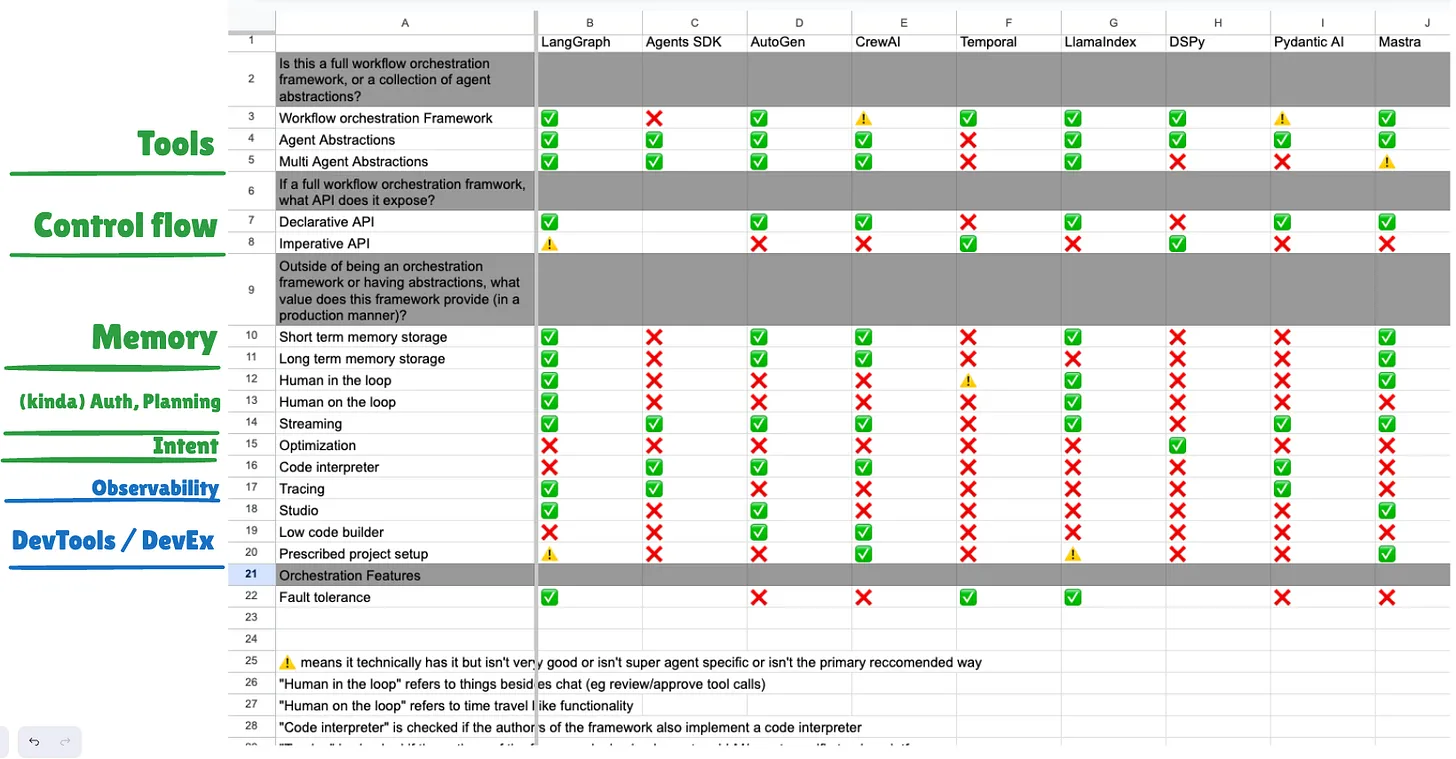
    In the Matter of OpenAI vs LangGraph

    The article discusses the ongoing debate in the AI community between two approaches: using large language models (LLMs) directly versus integrating them with more structured workflows. This debate is highlighted by the recent release of OpenAI’s “Practical Guide to Building Agents,” which has received mixed reviews compared to Anthropic’s equivalent guide.

    At the heart of the battle is a core tension we’ve discussed several times on the pod - team “Big Model take the wheel” vs team “nooooo we need to write code” (what used to be called chains, now it seems the term “workflows” has won).
    …
    You should read Harrison’s full rebuttal for the argument, but minus the LangGraph specific parts, the argument that stood out best to me was that you can replace every LLM call in a workflow with an agent and still have an agentic system.

    • LangChain - How to think about agent frameworks
    • OpenAI - A practical guide to building agents

    Harrison Agent Frameworks table

    Introducing OpenAI o3 and o4-mini

    On April 16, 2025, OpenAI introduced two new AI models—o3 and o4-mini—marking significant advancements in reasoning capabilities and tool integration within ChatGPT.

    For the first time, our reasoning models can agentically use and combine every tool within ChatGPT
    …
    The combined power of state-of-the-art reasoning with full tool access translates into significantly stronger performance across academic benchmarks and real-world tasks, setting a new standard in both intelligence and usefulness.

    OpenAI o3 and o4-Mini Are More Impressive Than I Expected

    The article concludes that OpenAI’s o3 and o4-mini significantly advance AI capabilities, challenging Google’s dominance. These models integrate perception, action, and reasoning into a cohesive system, marking a new dimension in AI. Though not perfect, their capabilities and cost-effectiveness position them as strong competitors. Further testing is needed to fully grasp their potential and limitations.

    o3 and o4-mini are the first AI systems to approach full interactivity across three layers: modalities (perception), tools (action), and disciplines (cognition). Senses, limbs, cortex.
    In a way, this release marks the end of “AI model” as a useful category. We kept calling them models out of habit. But these should have been called systems all along.

    OpenAI Codex CLI

    The Codex CLI is open-sourced. Don't confuse yourself with the old Codex language model built by OpenAI many moons ago (this is understandably top of mind for you!). Within this context, Codex refers to the open-source agentic coding interface. [...]

    I like that the prompt describes OpenAI’s previous Codex language model as being from “many moons ago”. Prompt engineering is so weird.

    → 9:59 PM, Apr 21
    Also on Bluesky
  • TIL: Top AI News of Week 15

    TIL: Top AI News of Week 15

    đŸ’»

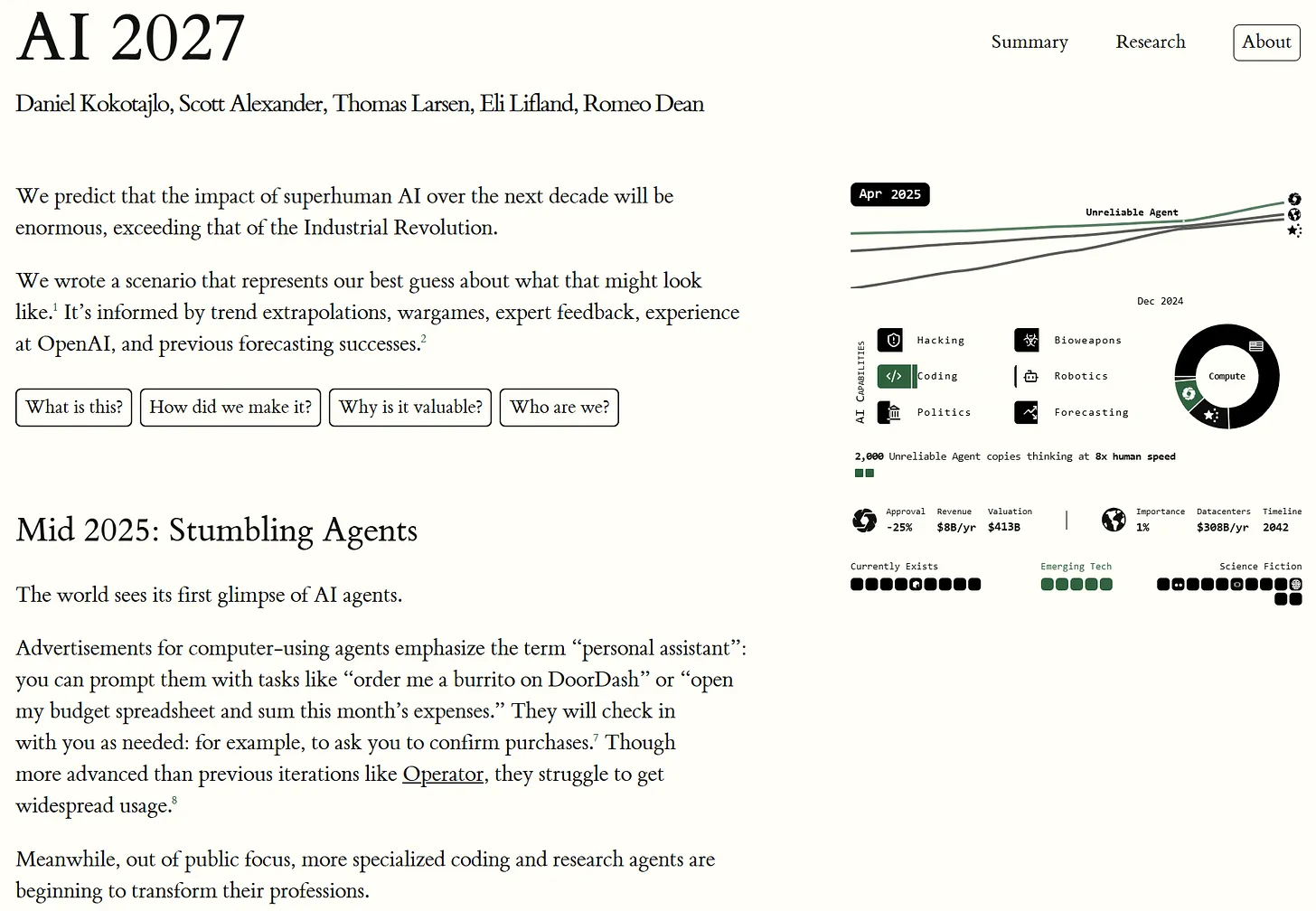
    AI 2027

    This website is a detailed scenario analysis predicting the potential impact of superhuman AI. Beside the content, this website provides a very good UX, the whole page is interactive. You can find the right side graph dynamic updates while scrolling.

    AI 2027 is a comprehensive and detailed scenario forecast of the future of AI. It starts in 2025 and projects the rise of AI agents by 2026, the complete automation of coding in early 2027, and the intelligence explosion in late 2027. It has two branches, one ending in AI takeover and another ending in utopia (sort of).

    AI 2027

    Making AI Actually Work on Your Team

    The article emphasizes the importance of AI in modern software engineering teams and provides practical advice for engineering leaders on how to integrate AI tools effectively. It highlights the need for leaders to guide their teams through this transition and create a supportive environment for experimentation.

    Seeing is believing First things first: try it yourself. … So get your hands dirty… Your personal experience matters here—without it, it’s all just theories in your head; you’ll be out of touch. … I gave him/her the honest truth: “It’s impossible for me to promise job security for anyone. But think about this logically: we hired you before AI was a thing, and now that you’re significantly more productive with these tools, why would we let you go?”

    Companies don’t (usually) fire their most productive people; they invest in them. The real threat isn’t AI—it’s sticking to outdated ways while the industry evolves around you. … The shift to AI-assisted engineering isn’t coming—it’s here.

    Making AI Actually Work on Your Team

    The Dynamic Between Domain Experts & Developers Has Shifted

    The article discusses how the relationship between domain experts and developers has changed in the AI era, emphasizing the increasing importance of domain expertise in building successful AI products. It’s interesting to see the sentence and picture of “I’ve got a great idea for an app
”.

    … But today, I’m seeing teams of domain experts wading into the field, hiring a programmer or two to handle the implementation, while the experts themselves provide the prompts, data labeling, and evaluations.

    For these companies, the coding is commodified but the domain expertise is the differentiator.

    I have got an app idea

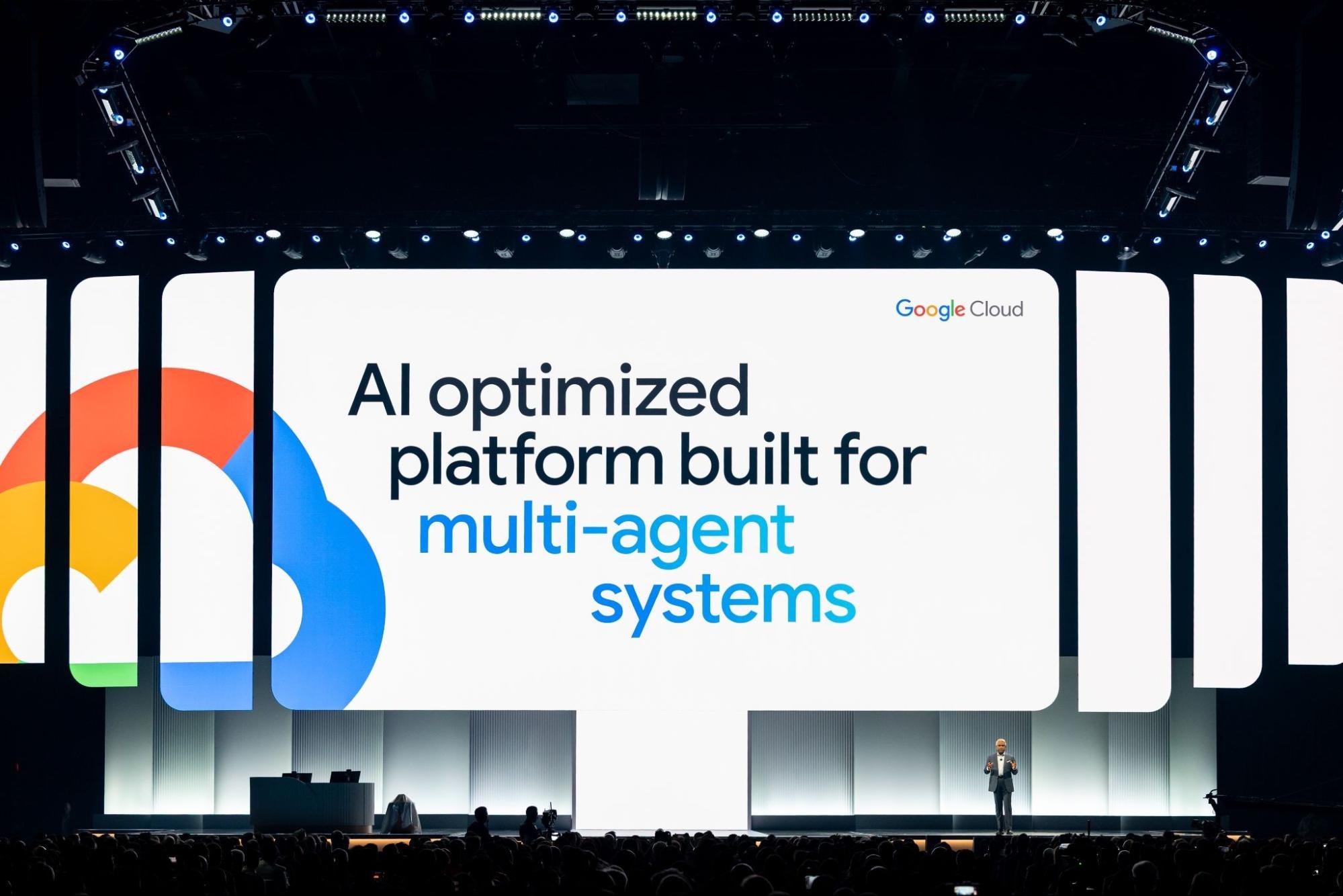
    229 things we announced at Google Cloud Next ‘25 – a recap

    Google Cloud Next 2025, held in Las Vegas, showcased over 200 announcements emphasizing advancements in AI, infrastructure, and real-world applications.

    Here’s a concise summary of AI & Machine Learning:

    • Gemini 2.5 Pro: Introduced as Google’s most advanced multimodal AI model, now in public preview across Vertex AI, AI Studio, and the Gemini app.
    • Agent Ecosystem: Launch of tools like Agentspace, Agent Development Kit, and Agent2Agent protocol to facilitate the creation and management of multi-agent AI systems.
    • Gemini Code Assist: An AI-powered coding assistant integrated into development workflows, offering features like a Kanban board for task management and insight into AI decision-making processes.

    Google Cloud Next 2025

    Google Is Winning on Every AI Front

    The article argues that Google and DeepMind have taken a significant lead in the AI landscape, outpacing competitors like OpenAI, Anthropic, and Meta. The author, who previously had high hopes for OpenAI, now believes that Google’s strategic and technical advancements have positioned it as the dominant force in AI.

    (PSA: Many people are interested in this post, so I removed the paywall)

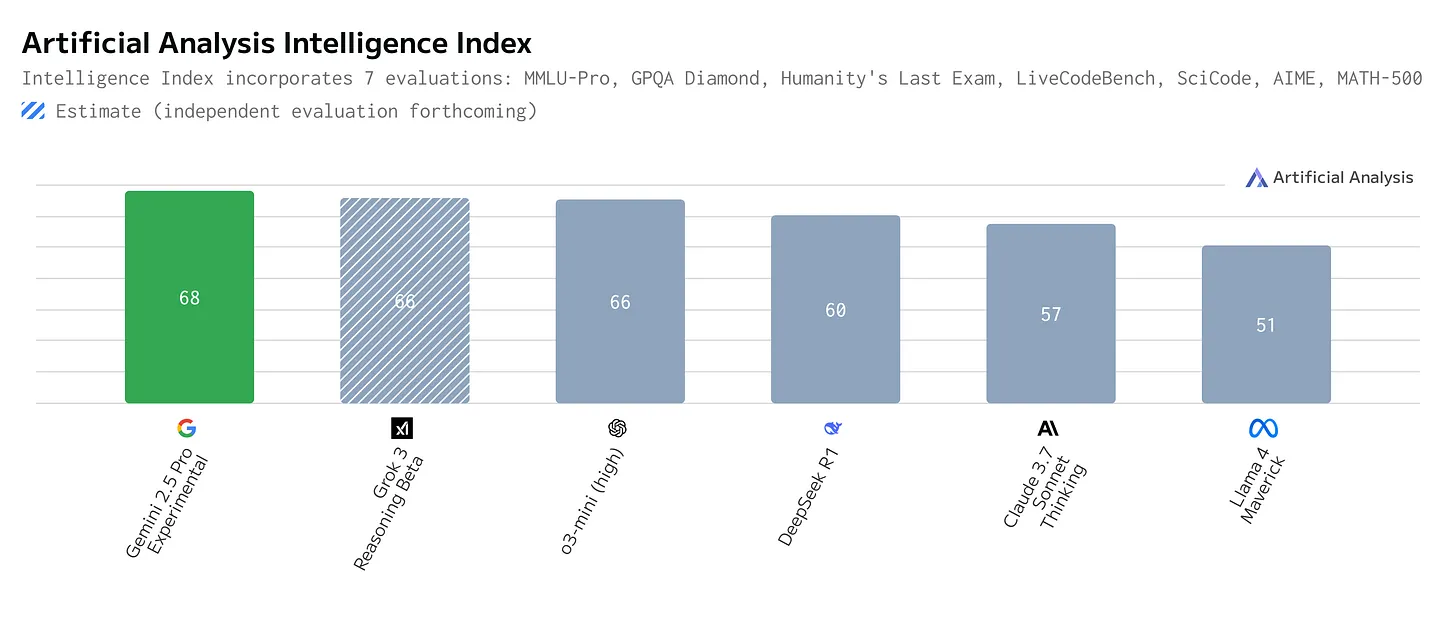
    Artificial Analysis Intelligence Index

    → 10:13 PM, Apr 14
    Also on Bluesky
  • 2025-04-10 TIL: AI Model Performance Analysis

    2025-04-10 TIL: AI Model Performance Analysis

    đŸ’»

    AI Model Performance Analysis

    This analysis highlights the tradeoffs between model size, speed, and tool-calling capabilities across different AI models. Llama3.1:8b appears to offer the best balance of features, while llama3.2:3b provides a good compromise between size and functionality.

    Model Size Speed Tool Calling Attributes & Notes
    llama3.1:8b 4.9G Good Very well Excellent tool calling capabilities with reasonable speed
    llama3.2:3b 2.0G Fast Well Fast performance with tool calling ability; provides confidence to continue testing. Sometimes lacks accuracy
    qwen2.5:7b 4.7G Fast Well Fast performance with good tool calling capabilities. Performance degrades after extended use
    qwq:32b 19G Slow Well Produces high-quality thought processes that are satisfying. Extremely slow, causing frustration during testing
    qwen2.5:0.5b 397MB Super fast No Exceptional speed due to small size. Unable to call any tools
    MFDoom/deepseek-r1-tool-calling:8b 4.9G Somewhat slow Poor Occasionally demonstrates thought processes. Slow performance with inadequate tool calling
    phi4-mini:3.8b 2.5G Fast No Fast performance and can identify tools. Unable to use the tools it identifies
    mistral:7b 4.1G Fast No Fast performance and can identify tools. Unable to use the tools it identifies
    ishumilin/deepseek-r1-coder-tools:1.5b 3.6G Fast No Fast performance and recognizes tools. Cannot answer questions or execute tools
    → 12:02 AM, Apr 11
    Also on Bluesky
  • 2025-03-24 TIL: Exploring .NET SDK Global.json, Google Map Tiles, and Vibe Coding

    2025-03-24 TIL: Exploring .NET SDK Global.json, Google Map Tiles, and Vibe Coding

    đŸ’»

    .NET SDK global.json

    In the context of the .NET SDK, global.json is a file that allows you to specify which .NET SDK version to use when running .NET CLI commands, ensuring consistent builds across different development environments. 

    • The .NET CLI searches for a global.json file in the current working directory (which isn’t necessarily the same as the project directory) or one of its parent directories. 
    • The global.json file allows you to specify the desired SDK version, ensuring that all developers and CI/CD pipelines use the same SDK version, which helps avoid build inconsistencies. 
    • A basic global.json file might look like this: 
    {
      "sdk": {
        "version": "8.0.404"
      }
    }
    

    Google Map Tiles

    Google offers 2D, 3D (Photorealistic), and Street View tiles via the Map Tiles API, enabling developers to build immersive and customized map visualizations, including access to roadmap, terrain, satellite imagery, and street-level views

    2D Tiles:

    • Image files that divide the world into an indexed grid, offering roadmap, terrain, and satellite imagery.
    • Ideal for basic map visualizations, navigation interfaces, and geographic data display.

    Photorealistic 3D Tiles:

    • 3D meshes textured with high-resolution imagery (OGC 3D Tiles format), providing realistic views of buildings, monuments, and landmarks.
    • Useful for stunning 3D perspectives, enhanced navigation, and storytelling.
    • Demo: Photorealistic 3D Tiles demo.

    Street View Tiles:

    • Panoramic street-level images that allow users to explore landmarks, natural wonders, and interiors of places like museums or restaurants.
    • Used for immersive experiences, virtual tours, and detailed location views.

    Vibe Coding

    Andrej Karpathy

    There’s a new kind of coding I call “vibe coding”, where you fully give in to the vibes, embrace exponentials, and forget that the code even exists. It’s possible because the LLMs (e.g. Cursor Composer w Sonnet) are getting too good.

    Semantic Diffusion

    
while complaining about how the definition of “vibe coding” is already being distorted to mean “any time an LLM writes code” as opposed to the intended meaning of “code I wrote with an LLM without even reviewing what it wrote”.

    “Official” illustrative GIF

    Personally I use “vibe coding” when I feel like this dog.

    → 9:09 PM, Mar 24
  • 2025-03-18 TIL: GeoParquet and .NET MAUI HybridWebView Control

    2025-03-18 TIL: GeoParquet and .NET MAUI HybridWebView Control

    đŸ’»

    GeoParquet

    Geospatial data in Parquet. Apache Parquet is a powerful column-oriented data format, designed as a modern alternative to CSV files. While Parquet excels at storing large and complex datasets, it lacks native geospatial support—which led to the creation of GeoParquet.

    GeoParquet is an incubating Open Geospatial Consortium (OGC) standard that introduces interoperable geospatial types (Point, Line, Polygon) to Parquet.

    • Establish a robust geospatial format for columnar workflows
    • Introduce columnar data formats to the geospatial world
    • Enable interoperability among cloud data warehouses

    HybridWebView

    HybridWebView is a new control introduced in .NET MAUI 9 that enables hosting HTML/JS/CSS content in a WebView while allowing two-way communication between JavaScript (inside the WebView) and C#/.NET (the host application).

    For example, you can embed an existing React JS application within a cross-platform .NET MAUI native app, using C# and .NET for the backend.

    • The entire app, including web content, is packaged and runs locally on the device.
    • The web content is hosted within a native WebView and functions within the app’s context.
    • The app can access external web services but does not require them.
    → 10:41 PM, Mar 18
    Also on Bluesky
  • 2025-03-12 TIL: Model Context Protocol (MCP) and OpenAI new tools for building Agent

    2025-03-12 TIL: Model Context Protocol (MCP) and OpenAI new tools for building Agent

    đŸ’»

    Model Context Protocol (MCP)

    MCP is an open protocol that standardizes how applications provide context to LLMs. Think of MCP as a USB-C port for AI applications—just as USB-C offers a standardized way to connect devices to various peripherals, MCP provides a universal way to link AI models with different data sources and tools.

    MCP helps you build agents and complex workflows on top of LLMs, ensuring seamless integration with data and tools. It provides:

    • A growing list of pre-built integrations that LLMs can directly plug into.
    • Flexibility to switch between LLM providers and vendors.
    • Best practices for securing data within your infrastructure.

    🔗 Resources:

    • A collection of MCP servers
    • Find Awesome MCP Servers and Clients

    OpenAI New Tools for Building Agents

    A new set of APIs and tools specifically designed to simplify the development of agentic applications:

    • Responses API – Combines the simplicity of the Chat Completions API with the tool-use capabilities of the Assistants API.
    • Built-in tools – Includes web search, file search, and computer use.
    • Agents SDK – Orchestrates both single-agent and multi-agent workflows.
    • Integrated observability tools – Enables tracing and inspection of agent workflow execution.

    MCP vs. OpenAI’s Tools

    Similarities:‹

    • ✔ AI Integration – Simplifies external data & tool connections.‹
    • ✔ Modular Design – Expandable & adaptable.

    Differences:

    • MCP is a protocol, OpenAI’s are proprietary tools.
    • MCP is open-source for cross-platform use; OpenAI’s tools optimize for its ecosystem.
    • MCP requires a custom server, while OpenAI’s tools offer easier direct integration.
    → 9:51 PM, Mar 12
    Also on Bluesky
  • 2025-03-11 TIL: GitHub Copilot in Visual Studio 2022 and new Chat in Cursor

    2025-03-11 TIL: GitHub Copilot in Visual Studio 2022

    đŸ’»

    Code with GitHub Copilot in Visual Studio 2022

    • Commit & PR Message Generation & Customization
    • Using Extensions to generate Mermaid Charts
    • Analyzing and improving code while debugging
    • Analyzing Exceptions with GitHub Copilot

    Cursor Chat

    A unified AI interface that combines Ask, Edit, and Agent modes to help you write, edit, and understand code directly in your editor. The interface offers three modes, selectable from the mode picker:

    • Agent: AI assistant that uses tools and reasoning to perform coding tasks with minimal supervision. (Agent can make up to 25 tool calls before stopping.)
    • Edit: Make single-turn edits to your code with precision and clarity.
    • Ask: Ask questions about your code, get explanations, and explore your codebase.
    → 9:59 PM, Mar 11
    Also on Bluesky
  • 2025-03-10 TIL: Arcade Expression

    2025-03-10 TIL: Arcade Expression

    đŸ’»

    ArcGIS Arcade

    ArcGIS Arcade, a basic scripting language from Esri, helps you map the values you need or create completely new data values in minutes.

    • Arcade is a portable, lightweight, and secure expression language used to create custom content in ArcGIS applications. Like other expression languages, it can perform mathematical calculations, format text, and evaluate logical statements. It also supports multi-statement expressions, variables, and flow control statements.
    • Arcade’s power lies in its portability across different ArcGIS applications. It provides a consistent syntax that can run on desktop, web, and mobile devices.

    Example: Constructing an ArcGIS Earth App Link from a Feature Popup:

    var geom = Geometry($feature);
    var x = geom.x;
    var y = geom.y;
    
    // Handle the Z-coordinate, defaulting to 500 if null or empty
    var z = DefaultValue(geom.z, 500);
    
    // Function to convert Web Mercator to WGS84
    function WebMercatorToWGS84(pt) {
        var x = pt.x / 20037508.34 * 180;
        var y = pt.y / 20037508.34 * 180;
        y = 180 / PI * (2 * Atan(Exp(y*PI / 180)) - PI / 2);
        return { 'x': x, 'y': y };
    }
    
    if (geom.spatialReference.wkid == 102100) {
        var coords = WebMercatorToWGS84(geom);
        x = coords.x;
        y = coords.y;
    }
    
    url = "[www.arcgis.com/home/item...](https://www.arcgis.com/home/item.html?id=7de2582460bb47e284b2adc5e6a6753b)";
    
    url = UrlEncode(url)
    
    var earthLink = "[earth.arcgis.app](https://earth.arcgis.app/?viewpoint=cam:)" + x + "," + y + "," + z + ";" + "" + "," + "" + ";&url=" + url;
    
    return earthLink;
    
    → 10:33 PM, Mar 10
    Also on Bluesky
  • 2025-02-26 TIL: Quid Pro Quo and Self-Adhesive Label Stickers

    2025-02-26 TIL: Quid Pro Quo and Self-Adhesive Label Stickers

    đŸŒ±

    Quid Pro Quo

    /ˌkwÉȘd prəʊ ˈkwəʊ/

    • Quid pro quo is a Latin phrase used in English to mean an exchange of goods or services in which one transfer is contingent upon the other—“a favor for a favor.”

    Self-Adhesive Label Stickers (揣揖çșž)

    Also known as index paper, self-adhesive label stickers were originally coated with glue, requiring users to lick them before sticking them to ledger pages or documents for notes or numbering. This practice led to the name 揣揖çșž, which refers to licking before use.

    Self-Adhesive Label Stickers
    → 9:50 PM, Feb 26
    Also on Bluesky
← Newer Posts Page 2 of 6 Older Posts →
  • RSS
  • JSON Feed
  • Lucky
  • Archive
  • About